

Investing in mutual funds can be confusing if you don’t understand how returns are calculated. SIP investors especially face a common question — How to know the correct returns of my mutual fund? That’s where XIRR comes in.
In this guide, we’ll explain what is XIRR in mutual fund, why it matters, how to calculate it, and how it differs from CAGR. You will understand XIRR using simple examples, easy formulas, and real investing scenarios just like those used by SEBI, AMFI, Moneycontrol, Groww, and ET Money.
Let’s begin.
What is XIRR in Mutual Fund?
XIRR stands for Extended Internal Rate of Return. It is a method used to calculate returns on irregular investments, such as SIPs (Systematic Investment Plans), where money is invested in small amounts over time.
Official Definition (as explained by AMFI & SEBI):
XIRR is the annualized return calculation method used for investments made at different time intervals and in varying amounts.
Why XIRR is required?
Most mutual fund investors invest monthly SIPs, not lump sum. Since the date and amount keep changing, normal return calculation does not work. XIRR gives the accurate annual return, considering:
- Different investment dates
- Different investment amounts
- Final redemption amount
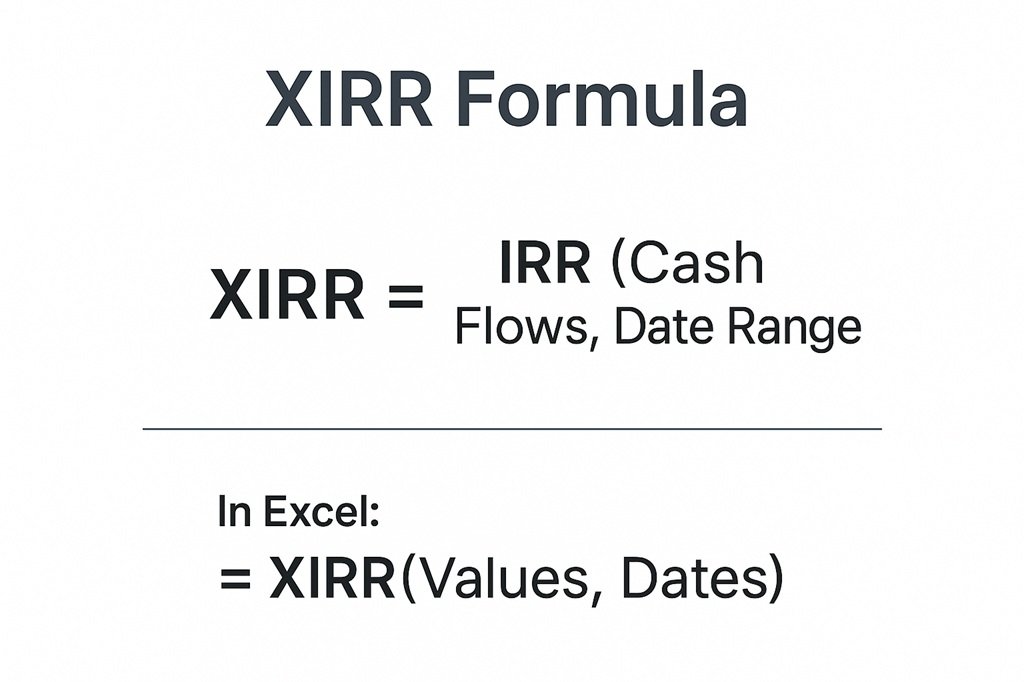
XIRR Formula (Finance/Excel)
If C0, C1, C2 … Cn are cash flows and D0, D1, D2 … Dn are respective dates:
XIRR = IRR (Cash Flows, Date Range)
In Excel:
= XIRR (Values, Dates)
Why XIRR Is Important for SIP Investors?
| Reason | Explanation |
|---|---|
| SIPs are irregular | Monthly or varied investments cannot use CAGR |
| Dates matter | Investing on 1st vs 30th affects returns |
| Redemption happens anytime | XIRR adjusts return till withdrawal date |
| Shows exact annualized return | Real yearly return analysis |
Simply put, SIP investors cannot depend on CAGR. XIRR is the only correct metric.
XIRR vs CAGR: What’s the Difference?
| Feature | XIRR | CAGR |
|---|---|---|
| Full Form | Extended Internal Rate of Return | Compounded Annual Growth Rate |
| Used For | SIP / Multiple transactions | Lump Sum investment |
| Considers Dates? | ✔ Yes | ❌ No |
| Return Type | Actual Annualized Return | Smoothed Annual Return |
| Best For | Regular Investors | Single Investment |
👉 CAGR works only for lump sum, while XIRR works for SIPs + lump sums.
How XIRR Works in Mutual Funds? (Real-Life SIP Example)
Imagine you invest ₹5,000 every month in a mutual fund through a SIP.
| Month | SIP Amount | NAV Bought |
|---|---|---|
| Jan 2024 | ₹5,000 | ₹50 |
| Feb 2024 | ₹5,000 | ₹48 |
| Mar 2024 | ₹5,000 | ₹52 |
| Apr 2024 | ₹5,000 | ₹55 |
| May 2024 | ₹5,000 | ₹60 |
Total Investment = ₹25,000
Suppose you redeem your investment in June 2024 for ₹29,500.
When calculating return:
- Your money was not invested on the same date.
- Market value increased differently.
- Each SIP has different maturity periods.
Hence, Excel will calculate XIRR for exact return.
Assume result = 18.3% XIRR
So your SIP made 18.3% annualized profit, not just simple gain.
How to Calculate XIRR in Excel/Google Sheets (Step-by-Step)
Step-by-Step Guide
- Open Excel or Google Sheets.
- Enter SIP values with negative sign (example:
-5000). - Enter the redemption amount in positive value.
- Mention the dates in the next column.
- Use the formula:
= XIRR (Values, Dates)
Example Input in Excel:
| Amount | Date |
|---|---|
| -5000 | 01-01-2024 |
| -5000 | 01-02-2024 |
| -5000 | 01-03-2024 |
| -5000 | 01-04-2024 |
| -5000 | 01-05-2024 |
| +29500 | 01-06-2024 |
Excel/Sheets will calculate your XIRR automatically.
How Brokers Show XIRR (Groww, Zerodha, Paytm Money, ET Money)
Popular investing apps automatically show XIRR:
| Broker/App | How It Displays |
|---|---|
| Groww | Direct XIRR shown in dashboard |
| Zerodha Coin | Shows “Internal rate of return (XIRR)” |
| ET Money | SIP return highlighted using XIRR |
| Paytm Money | Portfolio return yearly as XIRR |
You don’t need manual calculation, apps track all SIP dates for you.
Common Mistakes People Make with XIRR
| Mistake | Why Wrong |
|---|---|
| Comparing XIRR with Bank FD interest | XIRR is market-linked & fluctuates |
| Assuming XIRR remains constant | Returns change daily based on NAV |
| Calculating without dates | XIRR requires accurate investment dates |
| Using CAGR for SIP | CAGR gives wrong return for SIP investors |
XIRR Formula Explained with Simple Numbers
Let’s simplify XIRR:
- You put money at multiple times.
- Each time your return duration changes.
- XIRR checks return for each cash flow separately.
- Then annualizes it into a uniform yearly return.
Think of XIRR as finding the real yearly profit rate on your entire investment.
Benefits of Using XIRR for Mutual Fund Returns
✔ Accurate for SIPs
Handles monthly investments.
✔ Works for Lumpsum + SIP
Can calculate return for all investment styles.
✔ Considers Time Value of Money
Earlier investments gain more, later ones gain less — XIRR adjusts it.
✔ Annualized Return
Makes it easy to compare with FD, stocks, or PPF.
✔ Used by SEBI-Registered Platforms
Trusted and standardized calculation.
FAQs: What is XIRR in Mutual Fund
1. Is XIRR good for mutual funds?
Yes. XIRR is the most accurate way to measure SIP and irregular mutual fund investments.
2. What is a good XIRR percentage?
Typically, 10–15% XIRR is considered good for equity mutual funds over long term (5–10 years).
3. Why is my SIP XIRR low?
Because:
- Short-term holding (<2 years)
- Market volatility
- Recent high NAV purchases
4. What is the difference between Absolute Return, CAGR, and XIRR?
| Metric | Best For | Considers Dates? |
|---|---|---|
| Absolute Return | Short term | ❌ No |
| CAGR | Lump Sum | ❌ No |
| XIRR | SIP/Multiple Transactions | ✔ Yes |
5. Does XIRR work for lumpsum investments?
Yes, but CAGR is easier for lump sum. XIRR is best if you invest multiple times.
Conclusion: What is XIRR in Mutual Fund
Understanding what is XIRR in mutual fund is essential for every SIP investor. It is the only correct way to calculate your actual annualized return, considering investment dates, amounts, and redemption value. Whether you invest using Groww, Zerodha Coin, Paytm Money, or ET Money, the returns you see in your portfolio are shown using XIRR — because it reflects real-life investing patterns.
Also Read About:-) Compare Mutual Funds Before You Invest